About
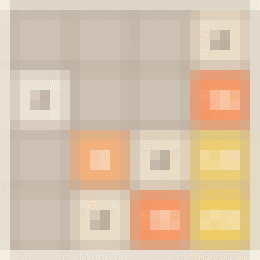
2048 is a sliding number puzzle played on a 4x4 grid. You swipe all tiles in one of four directions — every tile moves as far as possible, and identical adjacent tiles merge into their sum. The goal is to create a tile bearing the number 2048. It sounds simple. It is deeply, almost cruelly difficult to master.
The genius of 2048 is its exponential nature. Reaching 2048 requires building a chain from 2 to 4 to 8 all the way up — every merge perfectly sequenced. Random new tiles (always a 2 or 4) spawn after each move, threatening to disrupt your chain at any moment. One careless swipe can scatter your carefully arranged high-value tiles to opposite corners.
Games can last two minutes or twenty. The puzzle rewards spatial thinking, planning ahead, and the ability to recover from setbacks. It's endlessly replayable because you're always chasing a higher tile.
How to Play
- Use arrow keys or swipe to slide all tiles on the 4x4 grid in one direction.
- Two tiles with the same number that collide will merge into one tile with their sum.
- After every move, a new tile (2 or 4) appears in a random empty space.
- Build toward the 2048 tile by systematically merging smaller values.
- The game ends when no more moves are possible.
Tips
- Keep your highest-value tile in a corner and never move it away.
- Build a "snake" pattern — sequence values from corner outward in a U or S shape.
- Avoid moving tiles toward your highest tile's corner when possible.
History
2048 was created by 19-year-old Italian developer Gabriele Cirulli in March 2014 as a weekend project, inspired by the games 1024 and Threes. He released it as open source and it went viral within days, accumulating millions of plays. It became one of the most cloned and forked games in history. Despite the resemblance, Cirulli later acknowledged that Threes (released one month earlier) was the original mechanical template.