About
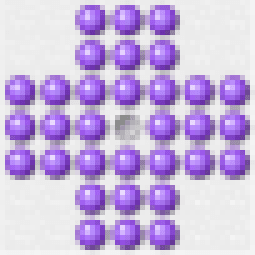
Peg Solitaire is a classic solo board puzzle played on a cross-shaped or circular board filled with pegs except for a single empty space. You remove pegs by jumping over them (like checkers), and the goal is to end with exactly one peg remaining — ideally in the center.
The puzzle is harder than it appears. Early in the game there are many moves available, but the board quickly becomes constrained. Sequences of jumps must be planned several steps ahead to avoid creating isolated pegs that can never be captured. Solving it perfectly is a genuine challenge.
Peg Solitaire has a long history of mathematical analysis. The number of possible games is enormous, but the number of ways to achieve a perfect one-peg finish is limited. Finding a solution path is a satisfying exercise in spatial planning.
How to Play
- Click a peg, then click the empty space on the other side of an adjacent peg to jump.
- The jumped-over peg is removed from the board.
- You can chain multiple jumps in one move if positions allow.
- Continue until no more jumps are possible.
- Win by ending with exactly one peg, ideally in the center position.
Tips
- Work from the edges inward — isolated pegs in corners are hard to remove later.
- Always check if a move you make will strand pegs in hard-to-reach spots.
- The classic solution for the English board follows specific pattern sequences — study one.
History
Peg Solitaire's origins are uncertain, but it was well-documented in France by the late 17th century. A legend (likely apocryphal) attributes it to a French nobleman imprisoned in the Bastille. The puzzle spread across Europe and became a popular parlor game in the 18th and 19th centuries. The English and French boards have slightly different shapes. Mathematician John Conway studied it extensively and proved deep results about which configurations are solvable.