About
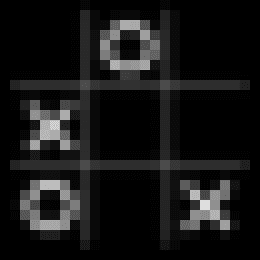
Tic-tac-toe is the simplest strategic game — and secretly an excellent teaching tool. Two players alternate marking X and O on a 3×3 grid. The first to get three in a row (horizontal, vertical, or diagonal) wins. With perfect play from both sides, every game ends in a draw.
As a pure game between experienced players, tic-tac-toe offers nothing — it's a known solved draw. But as a game against an AI at reduced difficulty, or as a teaching frame for game tree search and minimax algorithms, it's foundational. It's also the first game most children learn to play and represents the entry point into abstract strategy.
Browser tic-tac-toe is a 60-second diversion, useful when you need the absolute minimum commitment of mental engagement — a perfect between-tasks reset.
How to Play
- Players alternate placing their mark (X or O) in an empty square.
- X always goes first.
- First player to create three in a row — horizontal, vertical, or diagonal — wins.
- If all 9 squares are filled without a winner, the game is a draw.
Tips
- Always take the center on your first move — it gives you the most winning lines.
- If the opponent takes the center, play a corner.
- Block the opponent's two-in-a-row immediately; the only winning chance is if they miss a threat.
History
Tic-tac-toe's origins trace to ancient Rome with a game called Terni Lapilli, and similar grid games appear in ancient Egypt. The modern pencil-and-paper version has been played for centuries. The game gained computer science significance as the subject of one of the earliest AI programs — OXO, written by Alexander Douglas in 1952, was an unbeatable tic-tac-toe computer and one of the first programs to use a visual display. It remains the canonical example for teaching minimax search and game tree evaluation.